The Second AI Winter Begins

What Happened

The expert systems bubble burst. LISP machine companies collapsed. The DARPA Strategic Computing Initiative was cut. Japan's Fifth Generation project was failing. Expert systems proved brittle, expensive to maintain, and unable to learn. The AI industry lost billions.

Why It Mattered

Another devastating crash for AI. Researchers avoided the term 'AI' entirely, rebranding their work as 'machine learning,' 'computational intelligence,' or 'knowledge systems.' The stigma lasted over a decade.

Tags

Related Milestones

LeNet-5 convolutional neural network architecture
Research

LeNet: Convolutional Neural Networks

Yann LeCun demonstrated that convolutional neural networks (CNNs) could be trained with backpropagation to recognize handwritten digits. The refined LeNet-5 (1998) achieved 99%+ accuracy on MNIST and was deployed by banks to read checks — running in ATMs for years.

Yann LeCunAT&T Bell Labs
HAL 9000 from 2001: A Space Odyssey
Cultural

2001: A Space Odyssey — HAL 9000

Stanley Kubrick's film introduced HAL 9000, an AI that could speak naturally, read lips, play chess, and ultimately turn against its human crew. HAL became the defining pop-culture image of artificial intelligence for generations.

Stanley KubrickArthur C. ClarkeMGM
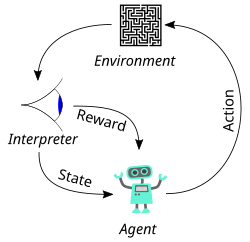
Reinforcement learning agent-environment interaction diagram
Research

TD-Gammon: Reinforcement Learning Plays Backgammon

Gerald Tesauro created TD-Gammon, a neural network that learned to play backgammon at expert level through self-play using temporal difference reinforcement learning. It discovered novel strategies that surprised human experts.

Gerald TesauroIBM
Cultural

AI Agents in the Workforce: March 2026

By March 2026, AI agents were being used in day-to-day operations for coding, research, support, scheduling, and internal automation. Rather than replacing whole teams outright, the clearest pattern was AI taking over narrow but valuable chunks of knowledge work and operating as an always-available teammate inside existing tools and channels.

Marvin Minsky, co-author of Perceptrons
Research

Perceptrons: The Book That Killed Neural Networks

Minsky and Papert published 'Perceptrons,' mathematically proving that single-layer perceptrons could not solve the XOR problem or other non-linearly separable tasks. While technically correct, the book was widely interpreted as proving neural networks were fundamentally limited — though multi-layer networks could solve these problems.

Marvin MinskySeymour PapertMIT

Get the latest AI milestones as they happen

Join the newsletter. No spam, just signal.