DENDRAL: The First Expert System

What Happened

DENDRAL automated chemical structure determination from mass spectrometry data. It used heuristic rules from domain experts to solve problems that normally required PhD-level expertise. Its successor Meta-DENDRAL could even generate new rules automatically.

Why It Mattered

Created the expert systems paradigm: encoding specialist knowledge in software to solve narrow, high-value problems. It proved AI could deliver practical results in scientific work long before the modern machine learning boom.

Key People

Organizations

Tags

Related Milestones

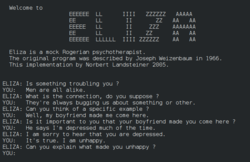
ELIZA chatbot conversation example
Research

ELIZA: The First Chatbot

Joseph Weizenbaum created ELIZA, a program that simulated a Rogerian psychotherapist using simple pattern matching. Despite being purely rule-based with no understanding, users became emotionally attached to it and insisted it truly understood them — a phenomenon Weizenbaum found deeply disturbing.

Joseph WeizenbaumMIT
Research

SHRDLU: Natural Language Understanding

Terry Winograd created SHRDLU, a program that could understand and respond to English commands about a simulated 'blocks world.' Users could ask it to move objects, answer questions about their arrangement, and even understand pronouns and context within its limited domain.

Terry WinogradMIT
Shakey the robot at the Computer History Museum
Research

Shakey the Robot

Shakey was the first mobile robot that could reason about its actions. It combined computer vision, natural language processing, and planning to navigate rooms, push objects, and solve simple tasks. It used the A* search algorithm and STRIPS planner.

Charles RosenNils NilssonStanford Research Institute
John McCarthy, organizer of the Dartmouth Conference
Research

The Dartmouth Conference

A two-month workshop at Dartmouth College where the term 'Artificial Intelligence' was officially coined. The proposal stated: 'Every aspect of learning or any other feature of intelligence can in principle be so precisely described that a machine can be made to simulate it.' This gathering brought together the founders of the field.

John McCarthyMarvin MinskyDartmouth CollegeMIT
Frank Rosenblatt, inventor of the Perceptron
Research

The Perceptron

Frank Rosenblatt built the Mark I Perceptron, the first hardware implementation of an artificial neural network. It could learn to classify simple visual patterns. The New York Times reported it as an 'Electronic Brain' that the Navy expected would 'be able to walk, talk, see, write, reproduce itself and be conscious of its existence.'

Frank RosenblattCornell Aeronautical Laboratory

Get the latest AI milestones as they happen

Join the newsletter. No spam, just signal.