SHRDLU: Natural Language Understanding

What Happened

Terry Winograd created SHRDLU, a program that could understand and respond to English commands about a simulated 'blocks world.' Users could ask it to move objects, answer questions about their arrangement, and even understand pronouns and context within its limited domain.

Why It Mattered

Demonstrated that computers could process natural language in context — but only in a tiny, controlled world. Highlighted the enormous gap between narrow and general language understanding.

Key People

Organizations

Tags

Related Milestones

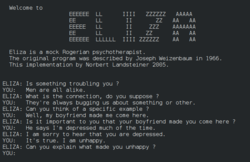
ELIZA chatbot conversation example
Research

ELIZA: The First Chatbot

Joseph Weizenbaum created ELIZA, a program that simulated a Rogerian psychotherapist using simple pattern matching. Despite being purely rule-based with no understanding, users became emotionally attached to it and insisted it truly understood them — a phenomenon Weizenbaum found deeply disturbing.

Joseph WeizenbaumMIT
John McCarthy, organizer of the Dartmouth Conference
Research

The Dartmouth Conference

A two-month workshop at Dartmouth College where the term 'Artificial Intelligence' was officially coined. The proposal stated: 'Every aspect of learning or any other feature of intelligence can in principle be so precisely described that a machine can be made to simulate it.' This gathering brought together the founders of the field.

John McCarthyMarvin MinskyDartmouth CollegeMIT
Shakey the robot at the Computer History Museum
Research

Shakey the Robot

Shakey was the first mobile robot that could reason about its actions. It combined computer vision, natural language processing, and planning to navigate rooms, push objects, and solve simple tasks. It used the A* search algorithm and STRIPS planner.

Charles RosenNils NilssonStanford Research Institute
Marvin Minsky, co-author of Perceptrons
Research

Perceptrons: The Book That Killed Neural Networks

Minsky and Papert published 'Perceptrons,' mathematically proving that single-layer perceptrons could not solve the XOR problem or other non-linearly separable tasks. While technically correct, the book was widely interpreted as proving neural networks were fundamentally limited — though multi-layer networks could solve these problems.

Marvin MinskySeymour PapertMIT
Research

DENDRAL: The First Expert System

DENDRAL automated chemical structure determination from mass spectrometry data. It used heuristic rules from domain experts to solve problems that normally required PhD-level expertise. Its successor Meta-DENDRAL could even generate new rules automatically.

Edward FeigenbaumJoshua LederbergStanford University

Get the latest AI milestones as they happen

Join the newsletter. No spam, just signal.