MIT
5 milestones · 1956–1969
Explore MIT's role in AI history across 5 milestones from 1956 to 1969, with the strongest concentration in research breakthroughs.
Chronology

The Dartmouth Conference
A two-month workshop at Dartmouth College where the term 'Artificial Intelligence' was officially coined. The proposal stated: 'Every aspect of learning or any other feature of intelligence can in principle be so precisely described that a machine can be made to simulate it.' This gathering brought together the founders of the field.

LISP Programming Language
John McCarthy created LISP (LISt Processing), a programming language designed specifically for AI research. Its features — recursion, dynamic typing, garbage collection, and homoiconicity — were decades ahead of their time.
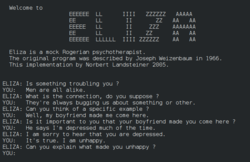
ELIZA: The First Chatbot
Joseph Weizenbaum created ELIZA, a program that simulated a Rogerian psychotherapist using simple pattern matching. Despite being purely rule-based with no understanding, users became emotionally attached to it and insisted it truly understood them — a phenomenon Weizenbaum found deeply disturbing.
SHRDLU: Natural Language Understanding
Terry Winograd created SHRDLU, a program that could understand and respond to English commands about a simulated 'blocks world.' Users could ask it to move objects, answer questions about their arrangement, and even understand pronouns and context within its limited domain.

Perceptrons: The Book That Killed Neural Networks
Minsky and Papert published 'Perceptrons,' mathematically proving that single-layer perceptrons could not solve the XOR problem or other non-linearly separable tasks. While technically correct, the book was widely interpreted as proving neural networks were fundamentally limited — though multi-layer networks could solve these problems.