Generative AI Revolution
2022–2024 · 16 milestones
ChatGPT brought AI to the masses. Generative AI exploded across every industry. The world woke up to a new technological era.
Milestones

Stable Diffusion: Open-Source Image Generation
Stable Diffusion was released as a widely available text-to-image model that could run on consumer hardware, with model weights distributed under an open release rather than an API-only product. Unlike DALL-E, anyone could download it, run it locally, and build on top of it. An explosion of community modifications, fine-tunes, and applications followed.

ChatGPT: AI Goes Mainstream
OpenAI released ChatGPT, a conversational AI based on GPT-3.5 fine-tuned with RLHF (Reinforcement Learning from Human Feedback). It reached 1 million users in 5 days and 100 million in 2 months — the fastest-growing consumer application in history. People used it to write emails, debug code, brainstorm ideas, and a thousand other tasks.
GPT-4: Multimodal Intelligence
OpenAI released GPT-4, a multimodal model that could understand both text and images. It passed the bar exam (90th percentile), scored 1410 on the SAT, and demonstrated remarkably nuanced reasoning. It was a massive leap from GPT-3.5 in accuracy, safety, and capability.

Claude: Constitutional AI
Anthropic released Claude, an AI assistant built with Constitutional AI (CAI) — a novel approach where the model is trained to follow a set of principles rather than just optimizing for human preference ratings. Anthropic, founded by former OpenAI researchers, positioned Claude as the safety-focused alternative.

Llama 2: Meta Opens the Floodgates
Meta released Llama 2, a family of widely available large language models (7B, 13B, 70B parameters) distributed as open weights under a custom license that allowed broad commercial use. While not open-source in the strict OSI sense, it gave companies and researchers access to a frontier-quality model they could run, customize, and deploy themselves.

Midjourney V5: Photorealistic AI Art
Midjourney V5 produced images so photorealistic that AI-generated photos went viral and were mistaken for real photographs — including a fake image of the Pope in a puffer jacket and fake photos of Trump's arrest. The line between AI-generated and real imagery effectively dissolved.

Mixtral 8x7B: Efficient Mixture of Experts
French startup Mistral AI released Mixtral 8x7B, a mixture-of-experts model that matched or beat GPT-3.5 while using a fraction of the compute per token. It demonstrated that clever architecture could compete with brute-force scaling.

Gemini: Google's Multimodal Response
Google launched Gemini, its most capable AI model family, natively multimodal across text, code, images, audio, and video. Gemini Ultra matched or exceeded GPT-4 on many benchmarks. It marked Google DeepMind's full response to OpenAI's dominance.
Sora: AI Video Generation
OpenAI previewed Sora, a model that could generate photorealistic videos up to a minute long from text descriptions. The quality stunned the world — realistic physics, complex camera movements, and coherent scenes that looked like professional cinematography.
Claude 3: Approaching Human-Level
Anthropic launched the Claude 3 family (Haiku, Sonnet, Opus), with Claude 3 Opus matching or exceeding GPT-4 on most benchmarks. It featured a 200K token context window, strong reasoning, nuanced instruction-following, and a 'personality' that users found distinctively thoughtful and careful.
GPT-4o: Omni Model
OpenAI released GPT-4o ('omni'), a unified model that natively processed text, audio, images, and video with near-instant response times. It could hold natural voice conversations with emotional expression, sing, laugh, and respond to visual input in real time.
Gemini 1.5 Pro: Million-Token Context
Google released Gemini 1.5 Pro with a 1 million token context window (later extended to 2M) — able to process entire codebases, books, or hours of video in a single prompt. It could find a needle in a haystack across millions of tokens with near-perfect recall.
Llama 3: Open-Source Catches Up
Meta released Llama 3 (8B and 70B, later 405B), closing the gap with closed frontier models. The 405B release put near-frontier open-weight models into more developers' hands, even though Meta's licensing still sat outside a strict open-source definition.
OpenAI o1: Reasoning Models
OpenAI released o1, a model trained to 'think before it speaks' using chain-of-thought reasoning at inference time. It could solve complex math, coding, and science problems by spending more compute thinking through multi-step solutions — trading speed for accuracy on hard problems.

EU AI Act: First Major AI Regulation
The European Parliament approved the AI Act, the world's first comprehensive AI regulation. It established a risk-based framework: banning 'unacceptable risk' AI (social scoring, indiscriminate surveillance), heavily regulating 'high risk' applications, and requiring transparency for generative AI.
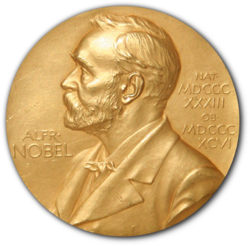
Nobel Prizes Awarded for AI Work
The 2024 Nobel Prize in Physics went to Geoffrey Hinton and John Hopfield for foundational work on neural networks and machine learning. The Nobel Prize in Chemistry went to Demis Hassabis and John Jumper (AlphaFold) alongside David Baker for computational protein design. AI research received the highest scientific recognition.
Categories in this Era
Popular Topics
Frequently asked questions
When was the Generative AI Revolution era of AI?+
The Generative AI Revolution era of artificial intelligence spans 2022 to 2024.
What defined the Generative AI Revolution era?+
ChatGPT brought AI to the masses. Generative AI exploded across every industry. The world woke up to a new technological era.
What are the key milestones of the Generative AI Revolution era?+
This era includes 16 milestones, among the most impactful: ChatGPT: AI Goes Mainstream (2022), GPT-4: Multimodal Intelligence (2023), Stable Diffusion: Open-Source Image Generation (2022), and Claude: Constitutional AI (2023).