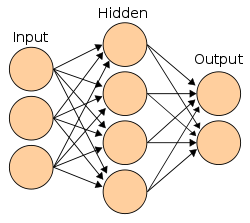
NETtalk neural network back-propagation diagram

NETtalk: Neural Network Learns to Speak

At a glance

Date
1987
Era
Expert Systems Boom (19801987)
Category
Research Breakthroughs
Impact
2 / 5
Key people
Terrence Sejnowski, Charles Rosenberg
Organizations
Johns Hopkins University

What Happened

NETtalk was a neural network that learned to pronounce English text aloud, starting from babbling sounds and gradually becoming intelligible — mimicking how a child learns to speak. It captured public imagination and demonstrated backpropagation's potential.

Why It Mattered

One of the first compelling public demonstrations of neural network learning. Showed these weren't just mathematical curiosities — they could learn real-world skills.

Key People

Organizations

Tags

Frequently asked questions

When did NETtalk: Neural Network Learns to Speak happen?+

NETtalk: Neural Network Learns to Speak took place in 1987.

Who was behind NETtalk: Neural Network Learns to Speak?+

For NETtalk: Neural Network Learns to Speak, key people included Terrence Sejnowski and Charles Rosenberg and organizations involved were Johns Hopkins University.

Why was NETtalk: Neural Network Learns to Speak important?+

One of the first compelling public demonstrations of neural network learning. Showed these weren't just mathematical curiosities — they could learn real-world skills.

Which era of AI history does NETtalk: Neural Network Learns to Speak belong to?+

NETtalk: Neural Network Learns to Speak is part of the Expert Systems Boom era (1980–1987) — a notable step in the research breakthroughs category.

Related Milestones

Geoffrey Hinton, pioneer of backpropagation in neural networks
Research

Backpropagation Rediscovered

Rumelhart, Hinton, and Williams published 'Learning Representations by Back-propagating Errors' in Nature, demonstrating that backpropagation could train multi-layer neural networks effectively. The same year, the PDP (Parallel Distributed Processing) group published their influential two-volume work on connectionism.

David RumelhartGeoffrey HintonUC San DiegoCarnegie Mellon University
John Hopfield, inventor of Hopfield networks
Research

Hopfield Networks: Physics Meets Neural Networks

Physicist John Hopfield showed that a type of recurrent neural network could serve as content-addressable memory, using concepts from statistical physics. The network would converge to stable states that could store and retrieve patterns — connecting neuroscience, physics, and computation.

John HopfieldCaltech
Reinforcement learning agent-environment interaction diagram
Research

TD-Gammon: Reinforcement Learning Plays Backgammon

Gerald Tesauro created TD-Gammon, a neural network that learned to play backgammon at expert level through self-play using temporal difference reinforcement learning. It discovered novel strategies that surprised human experts.

Gerald TesauroIBM
Artificial neural network diagram representing McCulloch-Pitts neuron model
Research

First Mathematical Model of Neural Networks

McCulloch and Pitts published 'A Logical Calculus of Ideas Immanent in Nervous Activity,' creating the first mathematical model of an artificial neuron. They showed that simple binary neurons connected in networks could, in principle, compute any function computable by a Turing machine.

Warren McCullochWalter PittsUniversity of Chicago
Frank Rosenblatt, inventor of the Perceptron
Research

The Perceptron

Frank Rosenblatt built the Mark I Perceptron, the first hardware implementation of an artificial neural network. It could learn to classify simple visual patterns. The New York Times reported it as an 'Electronic Brain' that the Navy expected would 'be able to walk, talk, see, write, reproduce itself and be conscious of its existence.'

Frank RosenblattCornell Aeronautical Laboratory

Get the latest AI milestones as they happen

Join the newsletter. No spam, just signal.