Support Vector Machines

What Happened

Vapnik and Cortes published their work on Support Vector Machines (SVMs), a method for finding maximum-margin decision boundaries in high-dimensional spaces with unusually strong theoretical guarantees. SVMs quickly became one of the leading approaches for classification problems across text, vision, and bioinformatics.

Why It Mattered

Became one of the defining machine learning methods of the late 1990s and 2000s. SVMs showed that statistical learning theory could yield practical, high-performance systems and helped carry machine learning forward during the long gap before deep learning took over.

Key People

Organizations

Tags

Related Milestones

LSTM recurrent neural network cell diagram
Research

Long Short-Term Memory (LSTM)

Hochreiter and Schmidhuber published the LSTM architecture, solving the vanishing gradient problem that plagued recurrent neural networks. LSTMs could learn long-range dependencies in sequential data by maintaining a memory cell with gates that controlled information flow.

Sepp HochreiterJürgen SchmidhuberTechnical University of Munich
Research

Samuel's Checkers Program

Arthur Samuel created a checkers-playing program at IBM that could learn from experience, improving its play over time. He coined the term 'machine learning' to describe programs that learn without being explicitly programmed.

Arthur SamuelIBM
LeNet-5 convolutional neural network architecture
Research

LeNet: Convolutional Neural Networks

Yann LeCun demonstrated that convolutional neural networks (CNNs) could be trained with backpropagation to recognize handwritten digits. The refined LeNet-5 (1998) achieved 99%+ accuracy on MNIST and was deployed by banks to read checks — running in ATMs for years.

Yann LeCunAT&T Bell Labs
Reinforcement learning agent-environment interaction diagram
Research

TD-Gammon: Reinforcement Learning Plays Backgammon

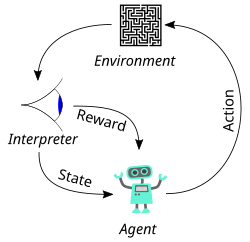
Gerald Tesauro created TD-Gammon, a neural network that learned to play backgammon at expert level through self-play using temporal difference reinforcement learning. It discovered novel strategies that surprised human experts.

Gerald TesauroIBM
IBM Deep Blue chess computer
Competition

Deep Blue Defeats Kasparov

IBM's Deep Blue defeated world chess champion Garry Kasparov in a six-game match (3.5-2.5). It was the first time a reigning world champion lost a match to a computer under standard tournament conditions. Deep Blue evaluated 200 million positions per second using brute-force search and hand-crafted evaluation.

Garry KasparovIBM

Get the latest AI milestones as they happen

Join the newsletter. No spam, just signal.