Samuel's Checkers Program

What Happened

Arthur Samuel created a checkers-playing program at IBM that could learn from experience, improving its play over time. He coined the term 'machine learning' to describe programs that learn without being explicitly programmed.

Why It Mattered

One of the first systems to improve through experience rather than fixed rules. Samuel also gave the field its enduring name: 'machine learning' would later become the dominant paradigm in AI.

Key People

Organizations

Tags

Related Milestones

Portrait of Alan Turing
Research

Turing's 'Computing Machinery and Intelligence'

Alan Turing published his landmark paper in the journal Mind, proposing the 'Imitation Game' (now known as the Turing Test) as a way to evaluate machine intelligence. He asked: 'Can machines think?' and argued the question itself was meaningless — what mattered was whether a machine could convincingly imitate human conversation.

Alan TuringUniversity of Manchester
Reinforcement learning agent-environment interaction diagram
Research

TD-Gammon: Reinforcement Learning Plays Backgammon

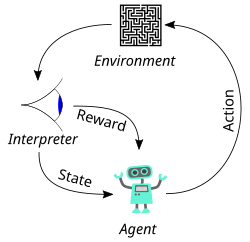
Gerald Tesauro created TD-Gammon, a neural network that learned to play backgammon at expert level through self-play using temporal difference reinforcement learning. It discovered novel strategies that surprised human experts.

Gerald TesauroIBM
Research

Logic Theorist: The First AI Program

Newell and Simon created the Logic Theorist, often called the first AI program. It could prove mathematical theorems from Whitehead and Russell's Principia Mathematica — and even found a more elegant proof than the original for one theorem. It was debuted at the Dartmouth Conference.

Allen NewellHerbert A. SimonRAND CorporationCarnegie Tech
John McCarthy, organizer of the Dartmouth Conference
Research

The Dartmouth Conference

A two-month workshop at Dartmouth College where the term 'Artificial Intelligence' was officially coined. The proposal stated: 'Every aspect of learning or any other feature of intelligence can in principle be so precisely described that a machine can be made to simulate it.' This gathering brought together the founders of the field.

John McCarthyMarvin MinskyDartmouth CollegeMIT
IBM Deep Blue chess computer
Competition

Deep Blue Defeats Kasparov

IBM's Deep Blue defeated world chess champion Garry Kasparov in a six-game match (3.5-2.5). It was the first time a reigning world champion lost a match to a computer under standard tournament conditions. Deep Blue evaluated 200 million positions per second using brute-force search and hand-crafted evaluation.

Garry KasparovIBM

Get the latest AI milestones as they happen

Join the newsletter. No spam, just signal.