Editorial Guide
History of Chatbots: From ELIZA to AI Agents
The chatbot is AI's oldest consumer-facing idea: a machine you can simply talk to. For most of its history the reality lagged far behind — pattern-matching scripts, brittle voice assistants — until large language models abruptly closed the gap. This page traces sixty years from ELIZA's fake psychotherapy sessions to conversational systems that act on your behalf.
Summary
The history of chatbots, from ELIZA's pattern matching in 1966 through Siri and Alexa to ChatGPT, Claude, and the shift from conversation to AI agents.
Timeline span
1966 to 2026 across 8 featured milestones.
Explore next
Jump into related tags, entity pages, and the full chronology below.
ELIZA: the first chatbot and the ELIZA effect
In 1966 Joseph Weizenbaum at MIT created ELIZA, a program that simulated a Rogerian psychotherapist by reflecting users' statements back as questions using simple pattern matching. It understood nothing — yet users became emotionally attached and insisted it truly understood them, a phenomenon Weizenbaum found deeply disturbing.
The 'ELIZA effect' — the human tendency to attribute understanding to machines that converse — became the founding observation of chatbot history. It presaged modern debates about AI companions and chatbot attachment by nearly six decades.
SHRDLU and the limits of rules
In 1968 Terry Winograd's SHRDLU could hold a genuine dialogue about a simulated world of blocks — moving objects on command, answering questions, resolving pronouns. Within its tiny domain it was startlingly capable, and it convinced many researchers that scaled-up rule-based language understanding was within reach.
It wasn't. SHRDLU's competence collapsed outside the blocks world, and the gap it exposed — between narrow scripted dialogue and open-ended understanding — defined why chatbots stagnated for the next four decades.
Siri, Alexa, and the voice assistant era
Apple's Siri (2011) and Amazon's Alexa (2014) put conversational interfaces in hundreds of millions of pockets and homes. They normalized talking to machines and built the always-listening hardware ecosystem — but under the hood they remained mostly intent-classification systems routing to scripted skills, and users quickly learned their rigid limits.
The voice assistants proved massive demand for conversational computing existed years before the technology could satisfy it. That unmet expectation is part of why ChatGPT's fluency landed with such force.
ChatGPT, Claude, and the LLM chatbot
On November 30, 2022, OpenAI released ChatGPT, a conversational interface over GPT-3.5 fine-tuned with human feedback. It reached 100 million users in two months — the fastest-growing consumer application in history — because for the first time a chatbot could actually hold up its end of nearly any conversation.
Anthropic's Claude followed in March 2023, trained with Constitutional AI to follow explicit principles. Within a year the chatbot went from a punchline to the primary interface through which the public experiences artificial intelligence.
From talking to acting: chatbots become agents
GPT-4o (2024) made conversation multimodal and near-instant — voice, vision, and text in real time. But the deeper shift was from conversation to action: by 2025-2026, systems like ChatGPT Work carried out whole jobs across applications and files rather than merely answering questions.
The trajectory that began with ELIZA reflecting statements back now points at conversational systems that observe, plan, and act. The chatbot was never really the destination — it was the interface through which AI agents arrived.
Milestone chronology
The essential timeline behind this guide, ordered chronologically.
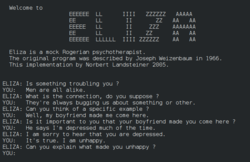
ELIZA: The First Chatbot
Joseph Weizenbaum created ELIZA, a program that simulated a Rogerian psychotherapist using simple pattern matching. Despite being purely rule-based with no understanding, users became emotionally attached to it and insisted it truly understood them — a phenomenon Weizenbaum found deeply disturbing.
SHRDLU: Natural Language Understanding
Terry Winograd created SHRDLU, a program that could understand and respond to English commands about a simulated 'blocks world.' Users could ask it to move objects, answer questions about their arrangement, and even understand pronouns and context within its limited domain.

Apple Launches Siri
Apple introduced Siri as a built-in feature of the iPhone 4S — the first major voice assistant integrated into a mainstream consumer device. Users could ask questions, set reminders, and control their phone with natural speech.

Amazon Echo & Alexa
Amazon launched the Echo smart speaker with Alexa voice assistant, creating an entirely new product category. Alexa could play music, control smart home devices, answer questions, and run third-party 'skills.' It brought always-on AI into the living room.

ChatGPT: AI Goes Mainstream
OpenAI released ChatGPT, a conversational AI based on GPT-3.5 fine-tuned with RLHF (Reinforcement Learning from Human Feedback). It reached 1 million users in 5 days and 100 million in 2 months — the fastest-growing consumer application in history. People used it to write emails, debug code, brainstorm ideas, and a thousand other tasks.

Claude: Constitutional AI
Anthropic released Claude, an AI assistant built with Constitutional AI (CAI) — a novel approach where the model is trained to follow a set of principles rather than just optimizing for human preference ratings. Anthropic, founded by former OpenAI researchers, positioned Claude as the safety-focused alternative.
GPT-4o: Omni Model
OpenAI released GPT-4o ('omni'), a unified model that natively processed text, audio, images, and video with near-instant response times. It could hold natural voice conversations with emotional expression, sing, laugh, and respond to visual input in real time.
GPT-5.6 and ChatGPT Work
OpenAI released GPT-5.6 in three tiers — Sol at the top, mid-range Terra, and the fast, cheap Luna — alongside ChatGPT Work, an agent built to carry out whole jobs rather than just answer questions: operating across applications and files, running long tasks, and producing documents, spreadsheets, and websites. Three weeks later OpenAI cut Luna's price by 80% and Terra's by 20% as competitive pressure mounted.
Related topics
Related entities
Related guides
History of Artificial Intelligence
The history of artificial intelligence, from 1943 neural theory through the Dartmouth Conference, AI winters, deep learning, and the LLM and agent eras.
HistoryHistory of Large Language Models
How large language models evolved from word embeddings and the transformer through BERT, the GPT line, ChatGPT, and reasoning models.
HistoryHistory of AI Agents
A narrative timeline of how AI agents evolved from theoretical ideas and brittle demos into real tool-using systems.
HistoryHistory of Generative AI
The history of generative AI, from GANs in 2014 through DALL-E, Stable Diffusion, ChatGPT, Midjourney, and Sora's text-to-video.
Frequently asked questions
What was the first chatbot?+
ELIZA, created by Joseph Weizenbaum at MIT in 1966, was the first chatbot. It simulated a Rogerian psychotherapist using simple pattern matching, reflecting users' statements back as questions. Despite having no understanding at all, users became emotionally attached to it — the first demonstration of what became known as the ELIZA effect.
What is the ELIZA effect?+
The ELIZA effect is the human tendency to attribute genuine understanding and intelligence to machines that hold conversations, even when they are following simple rules. It was named after ELIZA, the 1966 chatbot whose users insisted it truly understood them despite its creator Joseph Weizenbaum explaining it was pure pattern matching. The effect remains central to debates about AI companions and chatbot attachment today.
How did chatbots evolve into modern AI assistants?+
Chatbots evolved in three broad phases. Rule-based systems like ELIZA (1966) and SHRDLU (1968) matched patterns or worked only in tiny domains. Voice assistants like Siri (2011) and Alexa (2014) reached mass consumer scale but remained intent-classification systems with scripted skills. Large language models changed everything: ChatGPT (2022) and Claude (2023) could hold open-ended conversations, and by 2025-2026 conversational systems had become agents that act across applications rather than just answering questions.
What is the difference between a chatbot and an AI agent?+
A chatbot converses; an AI agent acts. Chatbots — from ELIZA through early ChatGPT — take a message and return a reply. AI agents use the same conversational interface but can also browse, call tools, edit files, execute code, and carry multi-step tasks forward with limited supervision. The shift became mainstream in 2025-2026 with systems like Claude Code and ChatGPT Work, which carry out whole jobs rather than merely answering questions about them.