Editorial Guide
History of Machine Learning
Machine learning is the idea that computers can improve at a task through experience instead of being programmed step by step. The term was coined by Arthur Samuel at IBM in 1959, decades before the field dominated AI. This page traces how that idea went from a checkers program teaching itself openings to the statistical methods, benchmark competitions, and deep networks that define modern AI.
Summary
The history of machine learning, from Arthur Samuel's checkers program and the perceptron through statistical learning, ImageNet, and the deep learning takeover.
Timeline span
1952 to 2013 across 8 featured milestones.
Explore next
Jump into related tags, entity pages, and the full chronology below.
Learning from experience: Samuel's checkers program
In 1952 Arthur Samuel of IBM built a checkers program that improved by playing against itself and adjusting its evaluation of board positions. By 1962 it beat a strong human player. Samuel coined the term 'machine learning' in 1959 to describe the approach: a computer getting better at a task without being explicitly reprogrammed.
The checkers program set the template that still defines the field — define a measurable objective, let the system adjust itself from data or self-play, and measure progress against human performance. Self-play in particular resurfaced decades later in systems like AlphaGo Zero.
The perceptron: learning in hardware
In 1957 Frank Rosenblatt built the Mark I Perceptron, the first hardware implementation of an artificial neural network that could learn to classify simple visual patterns. Breathless press coverage promised machines that would walk, talk, and be conscious — and the backlash to that hype, crystallized by Minsky and Papert's 1969 critique, helped trigger the first AI winter.
The perceptron matters to machine learning history because it established learning from examples as a physical, working mechanism rather than a theory, and because its boom-and-bust reception set the pattern of overpromise and disillusionment the field would repeat.
The statistical turn: TD-Gammon and support vector machines
Through the 1990s, machine learning quietly detached itself from symbolic AI. In 1992 Gerald Tesauro's TD-Gammon learned world-class backgammon through temporal-difference reinforcement learning and self-play, with no human strategy encoded. In 1995 Vladimir Vapnik and Corinna Cortes published support vector machines, a mathematically principled classifier that dominated practical machine learning for the next decade.
This was the era when 'AI' was a discredited label but machine learning thrived as applied statistics — spam filters, credit scoring, recommendation systems. The field learned to win on narrow, measurable problems while the grand ambitions waited for more data and compute.
Data and competitions: the Netflix Prize and ImageNet
In 2006 Netflix offered $1 million to any team that could improve its recommendation algorithm by 10%, turning machine learning progress into a public competition and popularizing ensemble methods. In 2009 Fei-Fei Li's team released ImageNet, over 14 million hand-labeled images, and its annual challenge became the benchmark that made computer vision progress measurable.
Together they demonstrated that large-scale data and shared benchmarks — not new algorithms alone — drive machine learning progress. ImageNet in particular became the launchpad for the deep learning breakthrough that followed.
Deep learning absorbs the field
In September 2012 AlexNet, a deep convolutional network trained on two consumer GPUs, won the ImageNet competition by an unprecedented margin. Traditional computer vision pipelines — hand-engineered features feeding a classical classifier — were abandoned almost overnight. In 2013 Word2Vec showed neural networks could learn meaningful vector representations of words at scale, bridging statistical NLP and the neural language models that led to transformers.
After 2012, 'machine learning' increasingly meant deep learning. The lineage from Samuel's self-improving checkers player runs directly through these systems to today's large language models, which are machine learning at the largest scale ever attempted.
Milestone chronology
The essential timeline behind this guide, ordered chronologically.
Samuel's Checkers Program
Arthur Samuel created a checkers-playing program at IBM that could learn from experience, improving its play over time. He coined the term 'machine learning' to describe programs that learn without being explicitly programmed.

The Perceptron
Frank Rosenblatt built the Mark I Perceptron, the first hardware implementation of an artificial neural network. It could learn to classify simple visual patterns. The New York Times reported it as an 'Electronic Brain' that the Navy expected would 'be able to walk, talk, see, write, reproduce itself and be conscious of its existence.'
TD-Gammon: Reinforcement Learning Plays Backgammon
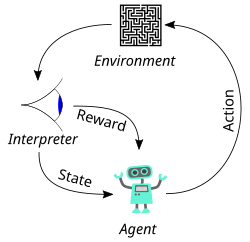
Gerald Tesauro created TD-Gammon, a neural network that learned to play backgammon at expert level through self-play using temporal difference reinforcement learning. It discovered novel strategies that surprised human experts.
Support Vector Machines
Vapnik and Cortes published their work on Support Vector Machines (SVMs), a method for finding maximum-margin decision boundaries in high-dimensional spaces with unusually strong theoretical guarantees. SVMs quickly became one of the leading approaches for classification problems across text, vision, and bioinformatics.

The Netflix Prize
Netflix offered $1 million to anyone who could improve their recommendation algorithm by 10%. The competition attracted thousands of teams and ran for 3 years (won in 2009). It popularized collaborative filtering, matrix factorization, and ensemble methods.

ImageNet: The Dataset That Changed Everything
Fei-Fei Li and her team created ImageNet, a dataset of over 14 million hand-labeled images in 20,000+ categories. Starting in 2010, the ImageNet Large Scale Visual Recognition Challenge (ILSVRC) became the benchmark for computer vision progress.

AlexNet: The ImageNet Moment
AlexNet, a deep convolutional neural network, won the ImageNet competition by a staggering margin — reducing the error rate from 26% to 16%. Trained on two NVIDIA GTX 580 GPUs, it was dramatically deeper and more powerful than previous entries. The AI community was stunned.

Word2Vec: Words as Vectors
Google researchers published Word2Vec, showing that relatively small neural networks could efficiently learn meaningful vector representations of words from large text corpora. The famous example `king - man + woman ≈ queen` made the idea vivid: semantic relationships could be captured geometrically in vector space.
Related entities
Related guides
History of Artificial Intelligence
The history of artificial intelligence, from 1943 neural theory through the Dartmouth Conference, AI winters, deep learning, and the LLM and agent eras.
HistoryHistory of Neural Networks
A history of neural networks and deep learning, from the 1943 artificial neuron through the perceptron, backpropagation, and the 2012 AlexNet breakthrough.
HistoryHistory of Large Language Models
How large language models evolved from word embeddings and the transformer through BERT, the GPT line, ChatGPT, and reasoning models.
HistoryMost Important AI Milestones
A curated shortlist of the AI milestones that most changed the direction, pace, or public meaning of the field.
Frequently asked questions
What is the history of machine learning?+
Machine learning began with Arthur Samuel's 1952 checkers program at IBM, which improved through self-play; Samuel coined the term in 1959. Frank Rosenblatt's 1957 Perceptron made learning from examples work in hardware. In the 1990s statistical methods like TD-Gammon's reinforcement learning (1992) and support vector machines (1995) dominated. Large datasets and competitions — the Netflix Prize (2006) and ImageNet (2009) — set the stage for AlexNet's 2012 deep learning breakthrough, after which deep neural networks absorbed the field and led to today's large language models.
Who coined the term machine learning?+
Arthur Samuel, an IBM researcher, coined the term 'machine learning' in 1959. His checkers program, first built in 1952, improved by playing against itself and adjusting how it evaluated board positions — an early demonstration that a computer could get better at a task through experience rather than explicit reprogramming. It beat a strong human player in 1962.
What is the difference between machine learning and AI?+
Artificial intelligence is the broad goal of making machines exhibit intelligent behavior; machine learning is a specific approach where systems improve through data and experience instead of hand-written rules. Early AI relied heavily on symbolic logic and expert-written rules. After expert systems failed in the late 1980s, statistical machine learning became the field's dominant method, and since AlexNet in 2012, most headline AI progress — including large language models — has been machine learning at scale.
What was the Netflix Prize?+
The Netflix Prize, launched in 2006, offered $1 million to any team that could improve Netflix's movie recommendation algorithm by 10%. It turned machine learning research into a public competition, popularized ensemble methods, and showed that shared benchmarks and real-world data could accelerate progress — a pattern ImageNet repeated for computer vision three years later.
When did deep learning take over machine learning?+
The turning point was September 2012, when AlexNet — a deep convolutional neural network trained on two consumer GPUs by Alex Krizhevsky, Ilya Sutskever, and Geoffrey Hinton — won the ImageNet competition by an unprecedented margin, cutting the error rate from 26% to 16%. Hand-engineered computer vision pipelines were abandoned almost overnight, and deep neural networks became the default approach across vision, speech, and language.