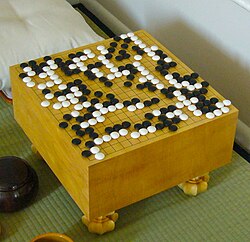
Go board representing AlphaGo Zero's self-play mastery

AlphaGo Zero: Learning From Scratch

What Happened

AlphaGo Zero achieved superhuman Go performance with ZERO human knowledge — no training data from human games, no hand-crafted features. It learned entirely through self-play, and within 40 days surpassed all previous versions, including the one that beat Lee Sedol.

Why It Mattered

Demonstrated that AI could surpass all human knowledge in a domain starting from nothing. Raised profound questions about the nature of human expertise and whether AI could discover strategies humans never imagined.

Key People

Organizations

Tags

Related Milestones

Google DeepMind logo
Research

DeepMind's DQN Masters Atari Games

DeepMind demonstrated a deep reinforcement learning agent (Deep Q-Network) that learned to play Atari 2600 games directly from pixel inputs, achieving superhuman performance on many games with no task-specific engineering. Google acquired DeepMind for ~$500 million shortly after.

Volodymyr MnihDemis HassabisDeepMind
Go board game, the game AlphaGo mastered
Competition

AlphaGo Defeats Lee Sedol

DeepMind's AlphaGo defeated Lee Sedol, one of the greatest Go players ever, 4-1 in a five-game match in Seoul. Go has more possible positions than atoms in the universe — brute force was impossible. AlphaGo used deep reinforcement learning and Monte Carlo tree search. In Game 2, AlphaGo played Move 37 — a move so creative that experts called it 'beautiful' and 'not a human move.'

Demis HassabisDavid SilverDeepMindGoogle
Google DeepMind logo, creators of AlphaStar
Competition

AlphaStar Masters StarCraft II

DeepMind's AlphaStar reached Grandmaster level in StarCraft II, a real-time strategy game requiring long-term planning, deception, and split-second tactics with incomplete information — far more complex than Go or chess.

DeepMind
Protein structure visualization representing AlphaFold's predictions
Research

AlphaFold 2: Protein Folding Solved

DeepMind's AlphaFold 2 solved the 50-year-old protein structure prediction problem, achieving accuracy comparable to experimental methods at CASP14. It could predict how proteins fold from their amino acid sequences — a problem that had stumped biologists for half a century.

John JumperDemis HassabisDeepMind
Residual network skip connection block diagram
Research

ResNet: Deeper Than Ever

Microsoft Research introduced ResNet with skip connections (residual connections), enabling the training of networks with 152+ layers — 8x deeper than previous networks. ResNet won ImageNet 2015 with 3.57% error, surpassing human-level performance (5.1%) for the first time.

Kaiming HeXiangyu ZhangMicrosoft Research

Get the latest AI milestones as they happen

Join the newsletter. No spam, just signal.