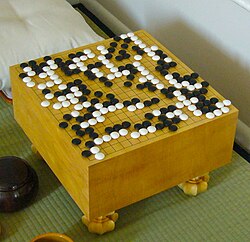
Go board game, the game AlphaGo mastered

AlphaGo Defeats Lee Sedol

What Happened

DeepMind's AlphaGo defeated Lee Sedol, one of the greatest Go players ever, 4-1 in a five-game match in Seoul. Go has more possible positions than atoms in the universe — brute force was impossible. AlphaGo used deep reinforcement learning and Monte Carlo tree search. In Game 2, AlphaGo played Move 37 — a move so creative that experts called it 'beautiful' and 'not a human move.'

Why It Mattered

Arguably the most shocking AI moment since Deep Blue. Go was considered decades away from being solved. Move 37 showed AI could be creative, not just efficient. 200 million people watched. Lee Sedol later retired from Go, saying 'AI cannot be defeated.'

Key People

Organizations

Tags

Related Milestones

Go board representing AlphaGo Zero's self-play mastery
Research

AlphaGo Zero: Learning From Scratch

AlphaGo Zero achieved superhuman Go performance with ZERO human knowledge — no training data from human games, no hand-crafted features. It learned entirely through self-play, and within 40 days surpassed all previous versions, including the one that beat Lee Sedol.

David SilverDeepMind
Google DeepMind logo, creators of AlphaStar
Competition

AlphaStar Masters StarCraft II

DeepMind's AlphaStar reached Grandmaster level in StarCraft II, a real-time strategy game requiring long-term planning, deception, and split-second tactics with incomplete information — far more complex than Go or chess.

DeepMind
Google DeepMind logo
Research

DeepMind's DQN Masters Atari Games

DeepMind demonstrated a deep reinforcement learning agent (Deep Q-Network) that learned to play Atari 2600 games directly from pixel inputs, achieving superhuman performance on many games with no task-specific engineering. Google acquired DeepMind for ~$500 million shortly after.

Volodymyr MnihDemis HassabisDeepMind
IBM Deep Blue chess computer
Competition

Deep Blue Defeats Kasparov

IBM's Deep Blue defeated world chess champion Garry Kasparov in a six-game match (3.5-2.5). It was the first time a reigning world champion lost a match to a computer under standard tournament conditions. Deep Blue evaluated 200 million positions per second using brute-force search and hand-crafted evaluation.

Garry KasparovIBM
Tomáš Mikolov, lead author of Word2Vec
Research

Word2Vec: Words as Vectors

Google researchers published Word2Vec, showing that relatively small neural networks could efficiently learn meaningful vector representations of words from large text corpora. The famous example `king - man + woman ≈ queen` made the idea vivid: semantic relationships could be captured geometrically in vector space.

Tomas MikolovGoogle

Get the latest AI milestones as they happen

Join the newsletter. No spam, just signal.